Clara Perry · 25 October 2026
Heritage Funding Allocations Intersect with Climate Pushback and Regional Transport Timelines in Post-Deal Britain
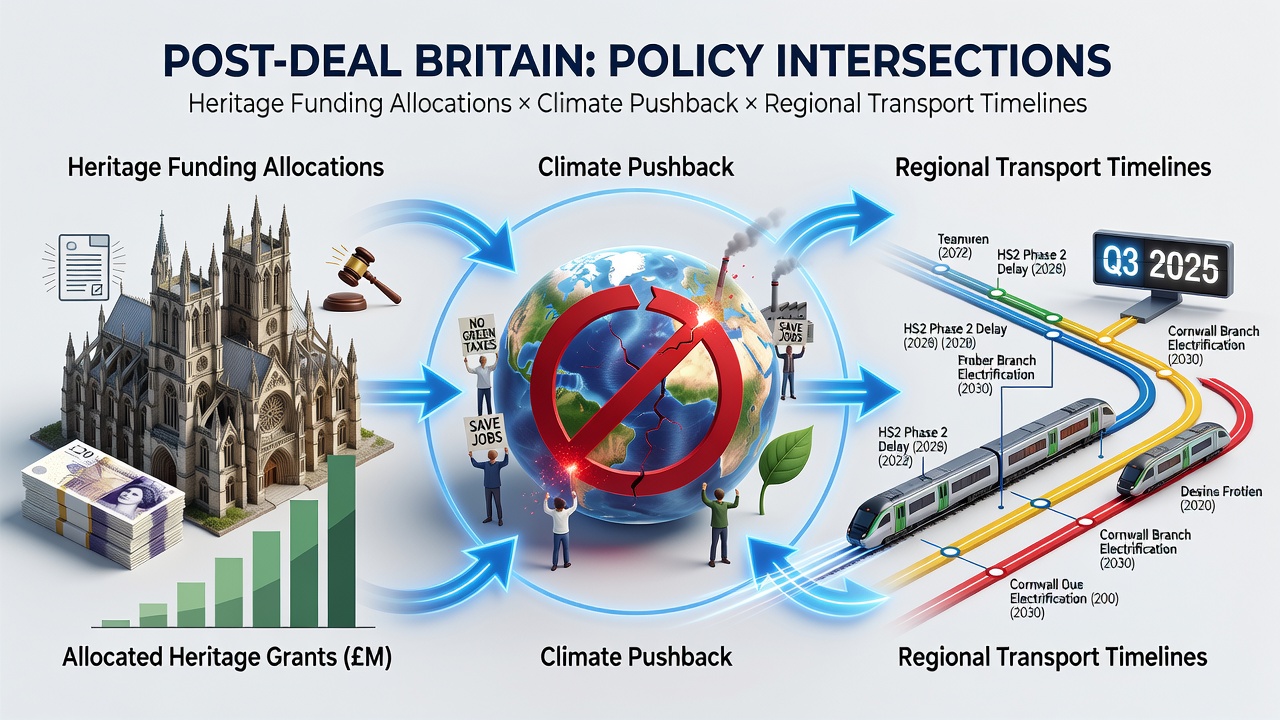
Data from government allocations shows heritage funding in post-deal Britain continues to navigate competing demands from climate initiatives and transport schedules, with October 2026 marking key review points for several regional projects. Observers note that allocations directed toward historic sites often encounter resistance when climate policies prioritize emission reductions, while transport timelines stretch due to overlapping compliance checks and budget reviews.
Heritage Funding Mechanisms and Their Current Scope
Allocations for heritage preservation draw from national and regional pools that support restoration of sites ranging from medieval structures to industrial landmarks, and these funds operate under frameworks established after trade agreements took effect. Reports indicate that amounts distributed in the 2025-2026 cycle reached specific benchmarks tied to maintenance needs, yet administrators must coordinate with environmental assessments that evaluate carbon impacts of renovation work. Those who've tracked these distributions find that heritage bodies submit detailed applications which now incorporate climate resilience metrics, such as flood defenses and energy-efficient materials, because regulations require alignment with broader sustainability targets.
Regional variations appear clearly in how northern and southern authorities manage their shares, with some areas channeling portions toward adaptive reuse of buildings that doubles as community spaces. Evidence from planning records reveals that delays in approval processes stem partly from requirements to model future climate scenarios before funds release, and this adds layers to what were once straightforward restoration timelines.
Climate Pushback and Its Influence on Project Approvals
Pushback against certain climate measures surfaces when heritage projects face objections from local groups concerned about visual or structural changes required for low-carbon adaptations. According to analyses from the European Environment Agency, similar tensions in other regions highlight how preservation goals can clash with mandates for renewable installations on protected facades, creating review backlogs that extend into late 2026. Data indicates these conflicts often resolve through negotiated compromises, such as discreet solar integrations or alternative heating systems that maintain historical integrity while meeting emission standards.
Researchers at institutions across Canada have documented parallel cases where heritage funding intersects with climate policies, showing that stakeholder consultations extend project durations by months. In Britain, this pattern repeats when environmental impact statements demand revisions to original plans, forcing reallocations that prioritize sites with lower resistance levels.

Regional Transport Timelines and Overlapping Constraints
Transport infrastructure schedules in post-deal Britain involve upgrades to rail and road networks that frequently border or traverse heritage zones, and these projects must synchronize with funding cycles that also support preservation efforts. Figures from the Department for Transport reveal that several corridors scheduled for completion phases around October 2026 now incorporate heritage impact assessments alongside climate adaptation features like green corridors and drainage improvements. Coordination challenges arise because transport contractors encounter additional permitting steps when routes affect listed buildings or archaeological areas, leading to phased implementations that stretch original deadlines.
What's notable is how these timelines intersect with climate pushback, as proposals for expanded highways or stations draw criticism for potential increases in emissions unless paired with mitigation strategies. Observers point to examples in the Midlands where heritage railways receive joint funding that supports both preservation and low-emission operations, yet integration requires multi-agency reviews that consume resources and time.
Intersections Across Funding, Climate, and Transport
Allocations for heritage sites often depend on transport connectivity for visitor access and material delivery, which means delays in one area ripple into others when climate requirements add further conditions. Studies from Australian research bodies on comparable post-agreement scenarios show that integrated planning reduces conflicts, and Britain has adopted similar approaches through joint task forces that evaluate heritage, transport, and climate factors simultaneously. Evidence suggests that without such coordination, projects risk fragmented outcomes where funds get redirected from one priority to address bottlenecks in another.
One case involves a northern heritage district where transport expansions were scaled back to accommodate climate buffers around historic structures, resulting in adjusted funding that supported alternative access routes. Those who've examined the records note that October 2026 reviews will assess whether these adjustments meet performance indicators set under current agreements, with data collection ongoing to inform future cycles.
Conclusion
Allocations continue to evolve as heritage needs, climate objectives, and transport demands converge in Britain's post-deal landscape, with October 2026 serving as a checkpoint for multiple initiatives. Reports from varied government sources confirm that ongoing adjustments reflect the need to balance these elements through structured reviews and collaborative frameworks.