Elena Richter · 10 October 2026
Emission Reduction Targets Face Industry Resistance Amid Overlapping Data Compliance Requirements and Regional Budget Constraints Following Trade Agreements
Industries across multiple sectors have pushed back against emission reduction targets set by governments in recent years, and this resistance has intensified as companies navigate additional layers of data protection regulations while regional authorities grapple with funding shortfalls in economies adjusting after major trade deals. Research from the European Environment Agency shows that manufacturing and energy firms reported compliance costs rising by 18 percent between 2024 and 2025, with many citing the combined burden of carbon reporting and data security mandates as a key factor. In October 2026, updates from the Australian Department of Climate Change, Energy, the Environment and Water indicated similar patterns, where export-oriented businesses highlighted how post-agreement supply chain shifts have strained local budgets allocated for green technology upgrades.
Corporate Responses to Carbon Reduction Mandates
Business groups in the automotive and chemical sectors have submitted formal objections to accelerated emission timelines, pointing to technical limitations in current abatement technologies and the need for extended transition periods. Data compiled by the U.S. Environmental Protection Agency reveals that over 120 large emitters requested deadline extensions in 2025 filings, citing integration challenges with digital monitoring systems required under new environmental frameworks. Observers note that these requests often coincide with broader adjustments in global trade dynamics, where tariff changes have redirected investment away from capital-intensive projects toward immediate operational needs.
Layered Data Regulations Add Complexity
Companies must now align emission tracking systems with data privacy standards such as those enforced under the EU's General Data Protection Regulation and Canada's Personal Information Protection and Electronic Documents Act, which creates overlapping reporting obligations. A study from the University of Melbourne's Centre for Corporate Law found that firms operating across borders spent an average of 14 percent more on compliance infrastructure in 2025 compared with prior years, largely due to the need for secure data handling in emission audits. What's significant is how these requirements have slowed project approvals in regions where local governments already face reduced revenue streams following trade pact implementations.
Regional Funding Pressures in Post-Deal Settings
Local authorities in several provinces and states have reported budget shortfalls that limit subsidies for industrial retrofits, with figures from Statistics Canada showing a 22 percent drop in dedicated environmental grants for smaller municipalities between 2023 and 2026. This situation intersects with industry concerns because many emission projects depend on public-private partnerships that have become harder to finance amid fluctuating trade flows. Experts at the International Institute for Sustainable Development have documented cases where planned wind and solar installations were scaled back after regional funding reallocations prioritized trade-related infrastructure repairs.

Case Examples from Affected Sectors
One logistics operator in the European market adjusted its fleet modernization schedule after data rule changes required separate consent protocols for vehicle telemetry used in emission calculations, according to records from the European Commission. Another example involves a Canadian mining consortium that delayed expansion plans when provincial budgets cut matching funds for low-carbon equipment, even as federal emission targets remained in place. These instances illustrate how the convergence of policy areas has prompted businesses to seek phased implementations rather than immediate compliance across all fronts.
Broader Economic Adjustments
Post-deal economic conditions have altered investment priorities, with capital flowing toward digital infrastructure that supports both trade documentation and environmental reporting. Reports from the Organisation for Economic Co-operation and Development indicate that cross-border data flows now account for a larger share of compliance spending in export-heavy industries, leaving fewer resources for direct emission reduction initiatives. Those who've analyzed trade agreement impacts note that currency fluctuations and new customs procedures have further tightened regional fiscal space, affecting the rollout of incentive programs designed to ease the transition to lower-carbon operations.
Conclusion
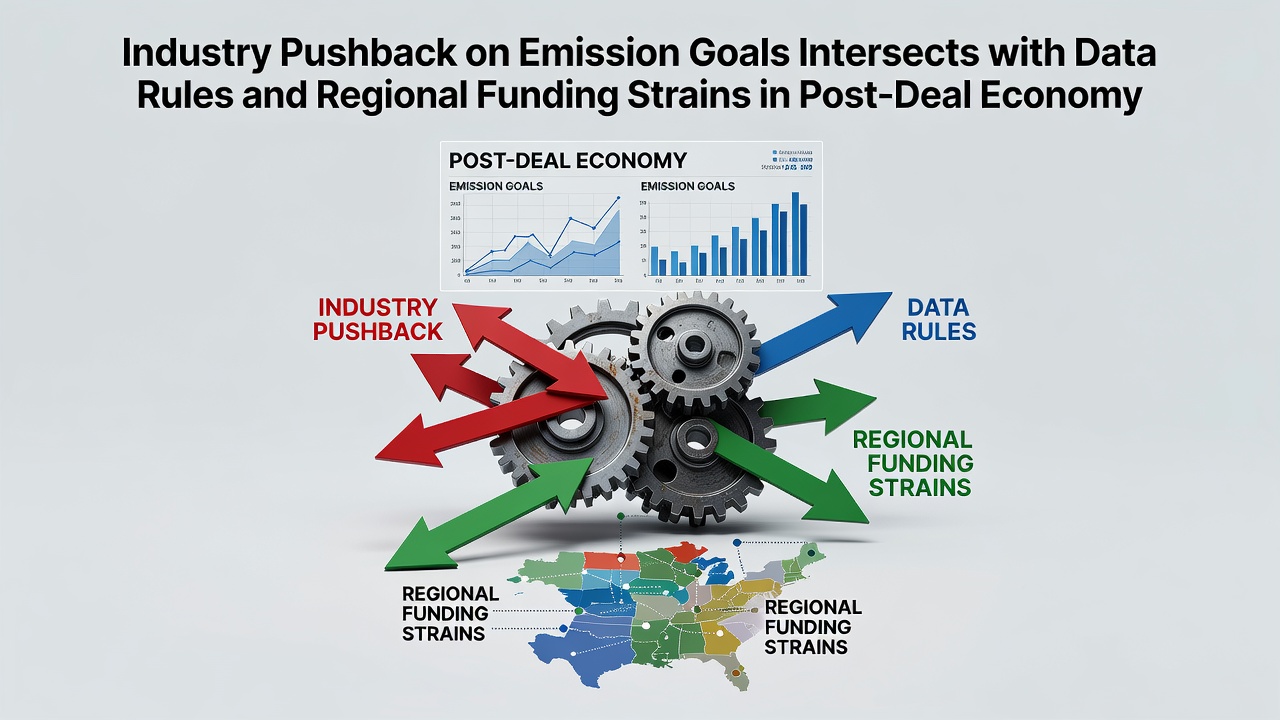
The interplay between industry resistance to emission goals, data compliance mandates, and regional funding limitations continues to shape policy responses in economies adapting to recent trade arrangements. Government agencies and research institutions continue to track these dynamics through updated filings and economic indicators, providing ongoing visibility into how sectors balance multiple regulatory demands. Future developments will depend on how authorities coordinate across environmental, data, and fiscal domains to address the documented strains.